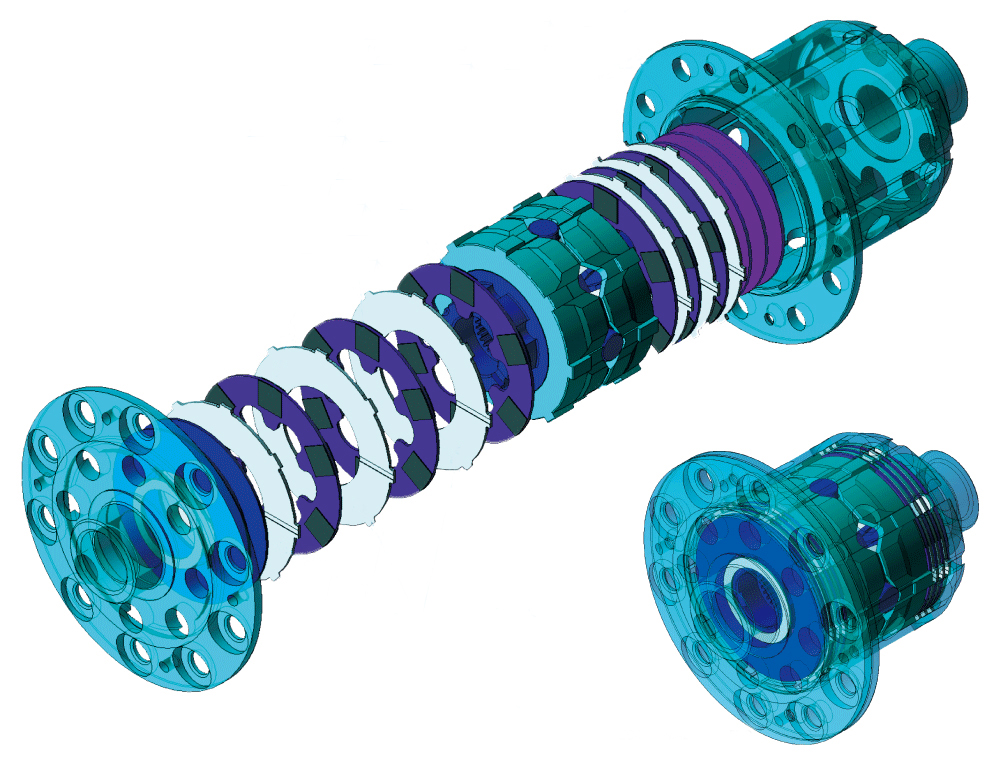
■Differential locking force is less than one-tenth that of a metal LSD. The differential locking force of a carbon LSD, which does not interfere with steering even when high initial torque is applied, is very strong as you can feel, but it is less than one-tenth that of a metal LSD. The differential locking force of a metal LSD is much stronger than the tire grip force, and the maximum value is greater than the strength of the drive shaft and the gears built into the LSD. In order to avoid the adverse effects of differential lock, a metal LSD needs to make the cam angle and initial torque extremely small to slow down the accelerator response, but this is not necessary at all with a carbon LSD, so the LSD responds quickly to the driver's operation, maximizing the driver's abilities.
■Diff-locking force is equal to tire grip force The differential locking force of a carbon LSD is smaller than tire grip on dry roads, and is comparable to tire grip on wet roads. This means that on dry roads, the steering is not disturbed even when accelerating, and on wet roads, the differential limiter can be safely controlled without losing grip by maintaining an appropriate throttle opening.
■Diff-locking force that resists slippageMetal LSDs have a very strong diff-locking force, but they can suddenly and unexpectedly slip due to changes in road surface or accelerator operation. This is due to the large difference between maximum static friction and kinetic friction of the metal plate in oil. Carbon LSDs have a small difference between maximum static friction and kinetic friction, so they have the property of stubbornly continuing to resist slippage.
■An ideal LSD that prevents drive loss without interfering with steering operation>br> The differential locking force near the tire grip force and sticky friction characteristics eliminate most of the unstable factors caused by the differential differential, so not only does it increase speed in races and competitions, but it also provides excellent driving stability on highways and in the rain. Furthermore, even with the high initial torque and sharp accelerator response, it is noiseless, making you forget the existence of the LSD on the street.
■Effect of initial torque It can be seen that the initial torque is very small compared to the magnitude of the drive torque. Rather than strengthening the diff-lock force when the accelerator is fully open, the initial torque has a large effect on the agility of the diff-lock in response to accelerator operation and the speed and sensitivity with which the tire grip condition is communicated to the driver. In order to bring out the best in the car and the driver, it is better to have as large an initial torque as possible without any negative effects.